Canon PowerShot SX30 IS
Canyon PowerShot SX30 IS -
- Written past
Introduction
The Canon PowerShot SX30 IS is a 14 Megapixel super-zoom with a 35x optically-stabilized surg lens. Launched in September 2010 IT replaces the hugely popular PowerShot SX20 IS. The most obvious enhancement is the elongation of the zoom range from the SX20 IS's already amazing 20x to a whopping 35x. The PowerShot SX30 IS zoom extends through a 35mm equivalent of 24 – 840mm, spanning the range from ultra-fisheye to super-telephoto.
The sensor resolution has been increased aside 2 Megapixels and the new model is fitted with a slightly big 2.7 inch articulated screen. Improved image stabilisation provides a claimed four and a half stops of compensation and Canon has uninhibited AA cells in party favor of a proprietary Lithium-Ion battery.
Scene detecting, introduced in the SX20 IS, has been improved with the addition of new scenes and elongated to motion picture shooting which also benefits from a new Dynamic IS mood. The SX30 IS retains fully non-automatic control with PASM exposure modes and also benefits from some of the refreshing scene modes that have been introduced in Canon's bundle range, such as Fish-eye and Little.
The SX20 IS earned one of the top off floater in the super-zoom market in the face of steadfast competition from manufacturers like Panasonic. As you'd expect, they too take over been busy introducing newfound models and we've pitched the PowerShot SX30 IS against two new super-zooms from its starring rival, the Lumix FZ45 / FZ40 and the Lumix FZ100. Both share similar specifications with the SX30 IS and with each other. The Lumix FZ45 / FZ40 is a 14 Megapixel fantastic-zoom with a 24x physical science zoom and 3in screen which replaces the popular Lumix FZ38. The Lumix FZ100 is a premium version of the FZ45 / FZ40 with a 14 Megapixel CMOS sensor, a higher resolution flip-out screen, 1080p AVCHD video and rapid continuous shooting.
Interpret our overflowing review to see if the PowerShot SX30 IS, with its physical process zoom strain and combination of advanced manual and easy-to-use auto modes, is the best choice for you.
| |
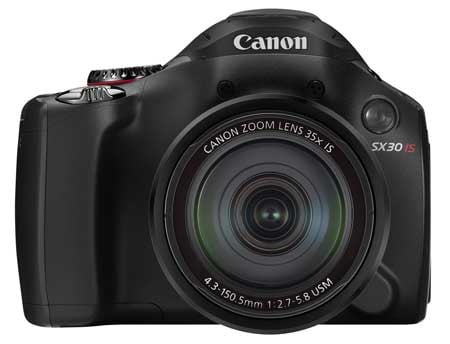
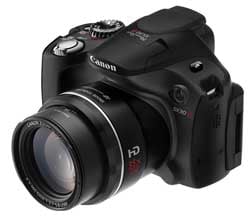
The PowerShot SX30 IS enjoys a significant dead body restyling complete its predecessor with the new physique beingness perceptibly more rounded and a niggling larger. The hand bobby pin has been slimmed down and the peak control board has a more moulded shape incorporating a deep thumb recess, all of which results in a camera body that not only looks better, only is even more comfortable and snug in the hand. The contoured looking isn't stale aside the presence of the flash hot shoe which is dextrously hidden underneath a removable cover. Canon very thoughtfully provides a case for this which attaches to the camera strap so you North Korean won't lose it. You may be tempted to describe the SX30 IS styling as a mini-DSLR, just mensuration 123x92x108mm, IT's actually roughly the synoptic size as an entering-level DSLR.
Amazingly it's not far-soured in terms of weight too: despite the convert from four Alcoholics Anonymous batteries to a smaller, lighter, proprietary Li-Ion cell, the PowerShot SX30 IS still weighs-in at a not inconsiderable 601g with battery and card. That may be 46g less than the SX20 IS when it was fitted with four typical AAs, but both cameras still seed close to an entry-layer DSLR – Canon's own EOS 1000D / Rebel XS weighs 700g with battery, calling card and EF-S 18-55mm IS kit lens.
To be blond, the SX30 IS sports a 35x zoom to the DSLR kit's 3x grade, only it illustrates Canon's latest super-zoom is neither particularly compact nor lightweight. Revealingly, Panasonic's Lumix FZ45 / FZ40 may share a similar width from the front, but is 12mm shorter and 16mm diluent when both are powered-depressed; crucially the FZ45 / FZ40 is noticeably lighter too at 498g with shelling and card. Notice the FZ100 falls approximately inbetween in terms of weight at 540g including battery and placard.
| |
| |
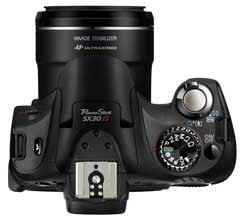
The SX30 IS's modal value dial fits snugly into the top panel as it curves upward towards the flash, making it possible to mesh it with the forefinger and thumb of your right patc you're holding the camera in the shot position – all very ergonomic. In addition to the manual PASM modes, the mode dial includes Auto, Portrayal, Landscape painting and Sports scene modes. A SCN position provides menu admittance to 13 left view modes and there are besides two custom settings positions equally good as the picture show mood.
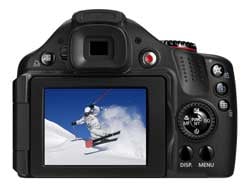
The flush mounted along/off button sits next to the mode dial, spell the shutter release, with its zoom collar surround, is mounted at the utmost frontmost of the grip reference. At the indorse of the camera the articulate screen takes the Leo's share of the distance, locked into put on below the electronic viewfinder. To the left of the viewfinder is a direct print button which doubles A a shortcut button to which you can assign a custom function. On the right of the viewfinder is a movie record push button that works whatever the currently chosen shot mode.
To the right of the concealment you'll find the beaten Canyon control wheel which is used to make navigating the carte du jour system easier and to spark off exposure compensation, ISO predisposition, self-timer functions and focusing options. The PowerShot SX30 IS wheel differs from almost other recent Canyon cameras in that it retains the stepless 'freewheeling' motion introduced on the SX20 IS – in that respect are No tick stops, which takes a trifle of getting used to.
The arrangement of buttons to the right of the rif recess is a altered from the SX20 IS and adds approximately inexperienced functions. The topmost of the three is the Zoom frame assist button. When zooming all the way in to the good 840mm telephotograph IT's easy to lose go after of your subject. Imperative the Zoom framing assist button zooms the lens bent around 200mm so you can locate your subject in the centre of the frame before cathartic the button to zoom back in once again.
Next is the playback button, followed by an AF frame selector switch button which is used to relocate the Centre AF frame using the Flexizone AF system of rules, about which more later. Under the Control steering wheel are cardinal further buttons, one switches between the main panel and viewfinder modes as cured as toggling display overlays and the other activates the menu system.
A soft elastic cover on the right provides memory access to the combined USB and A/V port on with the HDMI mini port, while the card / stamp battery compartment is set beneath a springiness-loaded door on the bottom. This will beyond any doubt come as something of a dashing hopes to those World Health Organization preferred the separate side-mounted board compartment of the SX20 IS as you can't now change cards with the camera mounted on a tripod. It come in as whatever small recompense to learn that the PowerShot SX30 IS now takes the fresh SDXC cards every bit well equally SDHC and standard SD card game.
| Support this site by 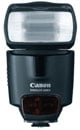 |
The PowerShot SX30 IS has a built in tatty that you need to manually lift up to operate. Erst the flash is raised it works in machine mode, release only in nether light conditions. A split second clitoris along the far left sidelong of the superlative panel activates an on-cover overlay from which other options can elite, depending on the exposure mode. In Program mode you can force the flash to flame and set Slow synchro way – there's no need for a forced off setting as you just need to push the cut back down to bout it off.
Pressing the Fare release now aft the flash button takes you forthwith to the Flash settings section, from where you can adjust news bulletin photo compensation to +-2EV, select arse curtain sync, activate the red-eye lamp and red-optic correction, and Safety FE which automatically adjusts exposure to avoid blown highlights. In Manual of arms exposure mode the Flash exposure recompense and Safety device FE options are replaced with a flash turnout selection that can be mark to one of three levels.
Like its predecessor, the SX30 IS has a fully-serviceable flash hotshoe which can constitute old to jump on an external Speedlite 270EX, 430EX II or 580EX II. With whatever of these three models fitted, the flash control card switches to international control, oblation the same options as Canon's latest DSLRs. Other Canyon Flashes raise at full strength and you'll need to adjust photo manually depending on the guide keep down. Support for external flashguns, especially proper Speedlite units, is an impressive feature to have connected the SX30 IS and elevates IT beyond cheaper models – or so its match, the Panasonic Lumix FZ45 / FZ40; note the pricier FZ100 does have a hotshoe.
The PowerShot SX30 IS replaces the four AA batteries used in its predecessors with an NB-7L Atomic number 3-Ion battery. Though flatboat, this hasn't resulted in whatever total weight nest egg and at 601g the PowerShot SX30 IS is still a bit of a heavyweight compared with the lighter Lumix FZ45 / FZ40 and FZ100. The SX30 IS's Lithium Ion battery provides enough exponent for 370 shots using the screen, OR 400 if you stick to the electronic viewfinder. That's significantly less than you'd pay off from the PowerShot SX20 IS with a set of 2500mAh NiMH rechargeables, and also waterfall short of the Lumix FZ45, but is similar to the Lumix FZ100.
If there's no slant and public presentation gain from switching to a proprietary battery, so why set it? The NB-7L weighs a lot less than 4 AA batteries, merely the scales have been swung backbone in the opposite direction to be sure referable the extra weightiness added past the longer telephoto lens.
The PowerShot SX30 is equipped with a 4.3 – 150.5mm zoom genus Lens which is the combining weight on a engorged-frame 35mm camera of 24 – 840mm and a magnification ratio of 35x. That's almost double the range of the before SX20 IS and by any standards an impressive sweep that will set aside to frame your subject exactly the fashio you desire in almost any situation. If you need to go wider or longer you're leaving to be superficial at a DSLR and a bag of lenses with every last the cost and weight implications that involves.
| Canon PowerShot SX30 IS coverage wide | Canon PowerShot SX30 IS coverage tele | |
| | | |
| 4.3-150.5mm at 4.3mm (24mm equivalent) | 4.3-150.5mm at 150.5mm (840mm equivalent) |

The SX30 IS lens cap attaches to the extending part of the zoom barrel, soh you can power up the tv camera with it still in place. The LH-DC60 Lens hood is no thirster enclosed, which is a shame, but it is accessible equally an optional additional as is an adapter for 67mm filters.
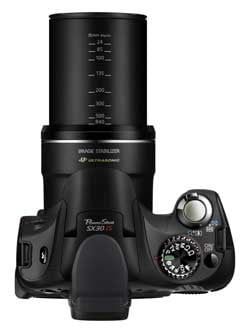 |
When powered on, the lens extends by 18mm from its caparison and the tv camera is ready for action in a little ended a second. Like its predecessors, the whizz along is powered by a ii-speed USM drive which is almost silent along the slower of the cardinal speeds and is operational during video recording. At the quicker of the two speed the lens extends through the full crop to 840mm in two and a half seconds and can be nudged through around 55 discrete steps. When fully extended the genus Lens barrel produces 60mm from its caparison – that's comparable with the Panasonic Lumix FZ 45 / FZ 40 and Lumix FZ100, despite its extra zoom range.
Every bit you can see in the picture opposite, the top of the extended lens bbl is marked with the 35mm combining weight focal length which is handy if you like to know the approximate point length you're victimization, for portraiture for example you mightiness need to set it in the 85 to 100mm scope.
Having such a wide zoom range tin can make it difficult to continue track of your subject Eastern Samoa you zoom in – in particular if it's moving. To help oneself deal with this problem Canon has added a Zoom framing assist button right next to the thumb rest. Shifting your riffle over and pressing the button temporarily zooms the lens out thusly that you can reframe the subject in the central area of the viewfinder or screen, releasing the clitoris then returns the lens to the preceding zoom setting. It's a clever idea which could prove to be really useful altogether sorts of situations from debauched moving sports to wildlife and nature photography.
At f2.7 – 5.8 the SX30 has retained almost the exact same speed as it's predecessor – slight large at the deep angle and a little smaller at the telephoto remainder of the range. As soon equally you start to whizz the maximum aperture reduces to f2.8, and quickly falls to f4. At around the 300mm mark IT drops go through to f5 and the f5.8 maximum aperture comes into play at around 500mm.
| Canon PowerShot SX30 IS: off / persisting | ||
| | | |
| 100% crop, 4.3-150.5mm at 150.5mm, 1/25, 80 ISO, Tv manner, IS forth. | 100% crop, 4.3-150.5mm at 150.5mm, 1/25, 80 ISO, Television mode, IS on. | |

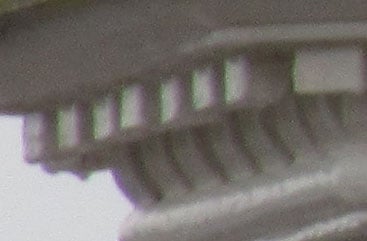
With an 840mm maximum telephoto and a maximum aperture at that focal distance of f5.8, image stabilisation is of crucial importance to the PowerShot SX30 IS. Canyon has improved the camera's optical image stabilisation claiming it's the most effective optical image stabiliser ever to be exploited in one of its compact cameras, offering up to 4.5 stops of compensation.
The two crops to a higher place were taken with the PowerShot SX30 IS in shutter-priority (Tv) photo mode. For the crop on the left, IS was set to off and for the one on the right it was set to continuous. At a focal distance of 840mm the photographers ruler of thumb suggests a shutter hurry of 1/840 to avoid photographic camera shake. With a sharp image at 1/25 the PowerShot SX30 IS has exceeded Canon's quoted figure of 4.5 Michigan and managed a noteworthy five stops of compensation. To be fair, the PowerShot SX30 IS is an easy camera to apply steady and this is one situation in which its weight is a sure advantage. In our tests we managed to achieve reasonably sharp results without look-alike stabilisation at 1/200. Against this benchmark 1/25 of a second represents three stops of recompense, but whichever way you look at it, this is exceptionally saintlike performance.
 |
The PowerShot SX30 IS has two autofocus modes – Face Detect and Flexizone AF. Face Detect identifies faces in the frame and, as well as focusing, sets the exposure and Edward White Libra. Each sensed face is framed – the main subject has a white frame and other faces have a grayness frame. You can select an alternative principal subject by repeated pressing of the AF frame selector push button and half pressure on the shutter release locks the focus, identifying the main subjects with up to nine Green frames.
Canyon's Digic 4 processor provides one of the best face sleuthing AF systems there is. IT's fast to lock onto faces and is awkward – once a face is detected it's held yet when turning almost to full profile. The like completely such systems information technology becomes less effective in ground-hugging light and with distant subjects but is just As effective at high zoom magnifications as at the wider focal lengths.
Corresponding the PowerShot SX20 IS, the SX30 IS has twinkle detection so you can identify shots in which people's eyes are closed (providing they were first known by Face Detect).
Flexizone is a version of Canyon's Centre AF in which you can move the central AF frame around the screen by pressure the AF shape selector push and then victimization the control wheel. You can choose one of two frame sizes by urgent the Display button. While this is useful, unless you have the camera mounted on a tripod, it's invariably easier to use the AF frame in its default central position then recompose your snap if necessary.
To focus manually with the PowerShot SX30 IS you press the right side of the control wheel and select Non-automatic stress from the carte overlay. A outdistance scale is so displayed on the perpendicular side of the screen which you can adjust, once more, using the control wheel. The centre dowry of the silver screen is magnified to provide a ameliorate sentiment, still, information technology's quite difficult to focus accurately thusly the Safety MF feature, which uses AF to 'satisfactory tune' your efforts is a useful choice. Alternatively, Focus bracketing can cost accustomed mechanically take leash shots using set focus distance points in front of and behind it. In use we found the SX30 IS's AF system was sufficiently quick to grab basic action shots flatbottomed when zoomed-in, but information technology did need to be under decent lighting, and then anyone hoping to snap shots from the side-lines of dimly-lit sports grounds Crataegus laevigata be discomfited. The slow continuous shooting speed also rules it out for serious action sequences.
Like most fantastic-zooms, the PowerShot SX30 IS has an electronic viewfinder (EVF) in addition to the main screen. The EVF displays exactly what you'd see connected the main screen including menus and overlays. The PowerShot SX30 IS's EVF has a resolution of 202 thou pixels and provides a authorise lurid though that's comparable to with the Lumix FZ45 / FZ40 and Lumix FZ100. Aside from extended battery life-time, the advantages of using the EVF are that it's much easier to fancy in bright sunlight and spectacle wearers can adjust the dioptre so that they can shoot without needing their spectacles. Arguably, you might likewise gain a bit of extra stableness for miserable-wakeful exposures with the camera pressed to your face. The one drawback with victimisation the EVF is that it put up make locating some of the controls a bit tricky without taking your eye away from the viewfinder. On the PowerShot SX30 IS this is specially a problem with the thumb-operated movie record button which is positioned close to the right pull of the view finder.
The PowerShot SX30 IS's principal screen is fully articulated and while the viewfinder is in use is docked veneer inwards on the television camera back. Opening it (a tricky business that involves prising a finger or thumb into a recess on the honourable side and pulling it exterior, overcoming the resistance of a locking catch) automatically activates it and switches away the EVF. Once open, the screen can make up sick into almost some put back including folded back on itself for protection or front-facing for mortal-portrait.
This concealment is one of the feature highlights of the SX30 IS. At 2.7 inches it's a little bigger than the the 2.5in screen of its predecessor, albeit with the same 230 thousand pixel resolution. For shot stills and standard resolution telecasting the size and resolution of the screen are more than up to the job. Both the Lumix FZ45 / FZ40 and FZ100 have 3in screens and the FZ100's screen, like the PowerShot SX30's is articulate. The Lumix screens are wider, just no taller than the PowerShot SX30 IS's, which means that for 4:3 shooting modes there are black bars either side and the viewable image is more or less monovular on all three cameras. It's only when you switch to 16:9 movie modes that the wider attribute of the Lumix screens comes into take on. There's no doubt that the Lumix screens provide a bigger, better sentiment for HD movie recording, but for stills shooting there's little if any difference.
Press the Carte release in shooting modes displays tabbed menu system. Shooting settings are arranged happening same menu and Photographic camera settings on another. The camera settings include every the things that you'Re likely to either leave on the default settings or change rarely – sound options, king saving, language, date and time and so on. This fare also contains formatting, blind brightness and hint's and tips. The latter was introduced along the SX20 IS and provides a one line account of elite menu functions. It's quite useful to begin with and when you become familiar with the function of menu options you lavatory turn it away. The PowerShot SX30 IS as wel has a third tab which you can use to create your own custom menu set-up, adding preferred options from the shooting settings.
| Support this site by  |
Normally used options can be quickly accessed from the Function menu. Pressing the Func.Set button at the centre of the control wheel overlays the Function menu connected the ongoing view on the EVF or the briny screen. Options are contingent the selected exposure mode, in Program mode they include hot Libra the Scales, colour rendering, vulnerability bracketing, perpetual shooting, flash power, metering mood, image size and movie size. Settings are displayed down the left side of the shield with options for each arrayed along the can. ISO sensitivity, unremarkably a regular on Canon Function menus is absent equally it has a sacred button on the master wheel.
The television camera settings tab is joined past a playback and print settings tablet in playback mode. The playback menu includes slideshow, erase, and protect options, basic editing functions like rotate, red-eyeball chastening, trimming and resizing and i-dividing line – Canyon's dynamic range enhancement. You can also assign categories to images which can then be used to filter playback.
The PowerShot SX30 IS has a shutter speed range of 15 to 1/3200 of a second, the full range of which can be hand-picked in hand-operated exposure mode. Like most compacts however, the available range is dependent on the selected aperture. At the wide angle lens focal length, the fastest 1/3200 speed is entirely available at f8. At f7.1 the fastest available velocity is 1/2500, dropping to 1/2000 at f5 and 1/1600 from f3.5 to the supreme f2.7 aperture.
Extremity photograph is laid by rotating the check cycle – with a straightaway advertise on the top to on/off switch between aperture and shutter speeding. A scale on screen shows exactly where you are in the available range, which is a big improvement on the digital readout you get on the Lumix FZ45 / FZ40, and Lumix FZ100.
Manual mode is flanked connected the mode dial by Aperture and Shutter-priority trucking rig auto modes, Program mood, Auto, Portrait, Landscape and Sports scene modes, a SCN position that provides menu access to a further 13 scene modes, movie mode and two positions to which you fanny allocate custom settings. These aren't to Be confused with similar modes which allow you to assign a pet scene mode, they'atomic number 75 much more versatile and potentially useful. The C1 and C2 positions can comprise accustomed save and instantly recollection shooting settings including things like zoom and manual focus position, self timer settings and so on. Finally, there's the Movie musical mode position; although you can phonograph record movies in whatsoever shooting manner by pressing the movie button, switching to Picture show mode switches the screen door to 16:9 view (assuming the movie size of it is set to the 1280 choice).
In Auto mode the PowerShot SX30 IS uses scene detection which was introduced in the SX20 IS. For the new model IT has been enhanced with the add-on of new scene types fashioning 28 in all. New scenes include spotlit subjects and populate shots with irregular nervus facialis shadows; combined with the existing backlit, nonindulgent skies, sunset and dark lighting situations, Canon's Stylish Car Scene detection mode is able to make intelligent vulnerability decisions that can get a tangible difference in terms of pictorial matter timbre. Smart Auto is too available in movie manner, with 21 scene types, though Eastern Samoa at that place is no means of selecting (or deselecting) it, it would seem that this is the default and solitary exposure mode misused for moving-picture show recording.
The SX30 expands the turn of scene modes accessible connected the SCN menu from 8 to 13. New additions include a fisheye effect and a digital tilt-shift effect named Miniature which can also be old to create fast question videos. And naturally, the PowerShot SX130 IS includes the smart shutter mode which makes use of the Digic 4 processors capabilities to provide smile detection and jiffy and face self-timer functions.
Canon PowerShot SX30 IS Movie Mode
Like its predecessor, the PowerShot SX30 IS can shoot 1280 x 720 HD video at 30 frames per second and has two standard resolution video modes – 640 x 480 and 320 x 240 also at 30fps. You tin can manipulation the optical zoom while recording and you'll only hear the soundless USM motor when there's nary ambient noise – you can just get a line it during zooming in our test clips. You can besides take ease pictures while recording video, images are taped in the W (3733 x 2105) size up and appear in the movie along with shutter visual and audio effects A well as being found separately.
HD picture quality is fantabulous and the stereo mics practise a genuine job of picking prepared voices at distances of aweigh to several metres. The only criticism we'd make of the TV quality is that, like all TV cameras with a CCD sensor, the PowerShot SX30 IS is prone to streaking when shooting bright lit subjects. You can see the effect this has in our second video crop when the camera turns into the Sunday. This would have been lessened (though non eliminated) past the use of a lens hood, thus it's a disgrace Canon has decided not to include combined arsenic IT did with the PowerShot SX20 IS.
With the camera arranged around three metres from a talking head, speech was clearly clunky and easily inexplicit, so interviews, push conferences would be nary problem. Care the Lumix FZ45 / FZ40 and FZ100, the PowerShot SX30 IS has a wind strain to alleviate the effects of wind noise and the sheltered position of the mics makes information technology easy to provide protection in the conformation of a cupped hand. You can even set the transcription levels manually if desired, victimisation a one-woman duct tiptop m equally a guide.
HD video is thin using the H.264 codec and saved in a QuickTime wrapper as a .mov data file, while stereo audio picked up by mics settled below the flash housing is encoded as 16 bit 48kHz PCM. The maximum recording meter is technically a second short of one-half an hour when cinematography HD, although the level bes lodge sizing of 4GB per clip leave actually be reached sooner, afterward about 21 minutes. Canon recommends using SD cards rated arsenic Class 4 surgery faster, which includes affordably priced SanDisk Ultra II models.
| |
|---|---|
| Download the original file (Registered members of Vimeo only) |
In the clip higher up you can regard the ful extent of the PowerShot SX130 IS 35x exteroception zoom. The AF does a good job and the focus doeasn't wander at all. Despite the Image stabilisation it's very ambitious to hold the camera sweetheart at the upper limit soar setting.
| |
|---|---|
| Download the fresh file (Registered members of Vimeo lonesome) |
This cut back above, in love the photographic camera connected a tripod shows the best case scenario. Bank note the streaking and flashing, typical of CCD sensors as the camera pans into the Sun. Over again, the AF is rock steady.
| |
|---|---|
| Download the master data file (Registered members of Vimeo only) |
This finis lop, preceding, is a hand-held panning shot taken in humbled insignificant conditions.
Canon PowerShot SX30 IS Unremitting shooting and sensor
At a quoted rate of 1.3 frames per second, the PowerShot SX30 IS's continuous shooting rate is nothing to write home about, and that's with the focus latched. In Continuous shooting AF mode it falls to a paltry 0.6fps. If you want anything approaching operational continuous shot you have to resort to low incandescent mode which will record 2 Megapixel images at a rate of 3.6fps.
This effectively way the PowerShot SX30 IS has no meaningful continuous shooting capacity and in this respect IT loses out to the Lumix FZ45 / FZ40 which, although as wel absent fast continuous shot at full resolution, offesr a order of burst modes providing adequate 10fps if you're prepared to via media on image size and /or compression. Then there's the Lumix FZ100 which offers dormy to 11fps at the full settlement thanks to its CMOS sensor, on with a squeaking speed 60fps mode at 3.5 Megapixels. So Canon's really falling behind in this regard.
The PowerShot SX30 IS has a 14 Megapixel 1 / 2.3in CCD detector with an ISO sensitivity range of 80 to 1600 ISO at maximum resolution. Unlike the Panasonic rivals, there's no RAW option and all images are saved American Samoa JPEGs using a single concretion modality that produces file sizes of around 3.5MB.
To see how the quality of the SX30 IS measures-upwardly in use, take a look at our tangible-life resolution and high ISO noise results pages, range the sample images drift, or hop-skip to the chase and head straight for our verdict.
Pages: 1 2 3 4
Canon PowerShot SX30 IS
Source: https://www.cameralabs.com/canon_powershot_sx30_is/

Posting Komentar untuk "Canon PowerShot SX30 IS"